
Case Study
Custom Data and Analytics Dashboard for Jonco Die Company

Overview
Jonco Die Company, a leader in precision die manufacturing, approached Acts Media, a custom software development company, to build a robust data and analytics dashboard. The goal was to create a centralized system that would provide real-time and historical insights into key business metrics such as employee hours, productivity, custom employee scorecards, department-level performance, and job-specific efficiency. This dashboard was designed to empower Jonco Die Company's leadership team to make data-driven decisions and optimize their workforce and operational performance.
Project Scope
The project included the development of a custom data and analytics dashboard that integrated seamlessly with Jonco Die Company's existing systems and provided actionable insights into the following key metrics:
-
1
Employee Hours – Tracking the total hours worked by each employee, broken down by department and job.
-
2
Employee Productivity – Analyzing individual and team productivity levels based on job completion and output.
-
3
Custom Employee Scorecards – Providing performance evaluations tailored to specific roles and responsibilities.
-
4
Company-Wide and Department-Level Data – Allowing managers to view performance at both macro (company-wide) and micro (department) levels.
-
5
Job Efficiency – Measuring the efficiency of employees on specific jobs to identify areas of improvement and optimization.
Challenges
- Data Fragmentation: Jonco Die Company's data was scattered across different systems, making it difficult to obtain a unified, real-time view of employee performance and operational efficiency.
- Lack of Customization: The existing reporting tools were generic and did not provide the level of customization needed to track specific employee metrics, job performance, or department-level data.
- Real-Time Insights: Jonco Die Company required a solution that could provide real-time insights, not just historical data, to help management make timely decisions during daily operations.
- User Accessibility: The solution needed to be user-friendly for employees and managers at all levels of the organization, from factory workers to executives, to encourage widespread adoption and usage.
Solution
-
Custom Data and Analytics Dashboard Development
Acts Media built a custom dashboard that integrated with Jonco Die Company's existing enterprise resource planning (ERP) system and workforce management tools. The dashboard was designed to be intuitive and easy to use, providing both real-time and historical data.
- User-Friendly Interface: The dashboard featured a clean, intuitive interface that allowed managers to quickly access key performance indicators (KPIs) and analytics. Customizable widgets and filters were implemented to allow users to drill down into the data as needed.
- Role-Based Access: The dashboard was designed with role-based access, ensuring that users could only view the data relevant to their level of responsibility. For example, a floor manager could access department-level data, while an executive could view company-wide performance metrics.
-
Tracking Employee Hours
One of the core features of the dashboard was the ability to track employee hours in real-time.
- Real-Time Hour Tracking: The dashboard integrated directly with Jonco Die Company's timekeeping system to provide accurate, real-time data on employee hours worked. Managers could see who was clocked in or out, total hours worked during the day, and overtime hours.
- Historical Data: The dashboard also allowed for historical tracking of employee hours, enabling management to identify trends, spot patterns, and assess staffing needs across different time periods.
-
Employee Productivity Insights
To measure and improve productivity, the dashboard included detailed analytics on individual and team performance.
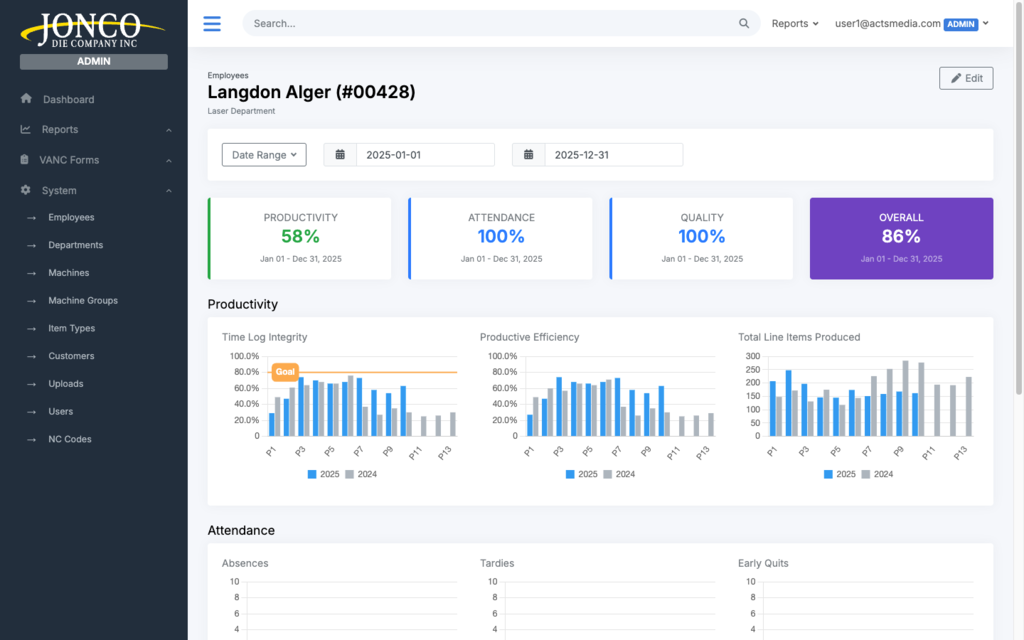
- Task Completion Rates: The system tracked task completion rates for each employee and provided productivity scores based on the number of tasks completed within the designated time frame.
- Output Comparison: The system allowed managers to compare individual employee productivity against departmental averages, fostering a competitive and performance-driven culture.
- Identifying Bottlenecks: By tracking productivity at both the employee and team levels, the dashboard helped Jonco Die Company identify inefficiencies or bottlenecks in specific processes or departments.
-
Custom Employee Scorecards
A unique aspect of the dashboard was the implementation of customizable employee scorecards that provided a comprehensive view of employee performance.
- Customizable Metrics: Each employee's scorecard was tailored to their specific role, whether they were on the production floor, in logistics, or in management. The scorecards took into account factors such as task completion, quality of work, adherence to safety protocols, and time efficiency.
- Employee Feedback: Employees could access their own scorecards, promoting transparency and encouraging continuous improvement. The scorecards also provided managers with a clear view of individual employee strengths and areas for development.
- Goal Tracking: Employees could set personal goals, and managers could track progress against these goals, fostering accountability and engagement.
-
Department-Level and Company-Wide Data
The dashboard allowed users to view data both at a granular department level and across the entire company.
- Department-Level Views: Managers could analyze data for their specific departments, including employee hours, productivity, and efficiency metrics. This allowed them to make informed decisions about resource allocation, staffing, and operational improvements.
- Company-Wide Performance: Executives could access company-wide performance dashboards to see aggregate data across all departments. This allowed them to make strategic decisions about company operations and growth.
-
Job-Specific Efficiency Tracking
The dashboard provided insights into the efficiency of employees on specific jobs, enabling Jonco Die Company to identify opportunities for optimization.
- Job-Level Efficiency Metrics: For each job or project, the system tracked the time spent, the number of tasks completed, and any delays. This enabled management to assess the efficiency of employees working on specific projects and identify areas for process improvement.
- Historical Job Data: The system provided historical data on job efficiency, allowing Jonco Die Company to analyze trends and make data-driven decisions about future projects or workflow optimizations.
Results
- Improved Operational Efficiency: With real-time data on employee hours and job efficiency, Jonco Die Company was able to make more informed decisions about staffing and resource allocation, leading to improved operational efficiency.
- Increased Employee Accountability: Custom scorecards provided employees with clear expectations and performance metrics, fostering a culture of accountability and continuous improvement.
- Enhanced Data-Driven Decision Making: The dashboard empowered managers and executives with both high-level and granular data, enabling them to make data-driven decisions that positively impacted overall company performance.
- Time Savings: By automating the tracking of employee hours, productivity, and job efficiency, the dashboard saved significant time for both employees and managers, allowing them to focus on more strategic tasks.
- Employee Satisfaction: The transparency provided by the scorecards and the ability for employees to track their own progress led to increased job satisfaction and engagement.
Conclusion
By developing a custom data and analytics dashboard for Jonco Die Company, Acts Media provided the company with a powerful tool to track employee performance, improve operational efficiency, and make informed decisions based on real-time and historical data. The dashboard's customizable features, real-time tracking capabilities, and department-level insights have significantly improved Jonco Die Company's ability to monitor and optimize its workforce, leading to greater productivity and overall business success. This project demonstrates how a tailored data solution can drive performance improvements and provide actionable insights in a manufacturing environment.